This month’s column comes from Stawell, where at time of writing, and publishing in the April edition Fire Wise - thousands of
volunteers have gathered for this year’s State Championships. Following five years at Mooroopna, the Championships moved to the west of the State this year, and were hosted by the Stawell Brigade in District 16 where they were ably supported by surrounding brigades across the Group and District, as well as local District management and staff, and the broader teams at CFA and VFBV who support these critical events. The local Host Committee did a fantastic job, and the locals welcomed members from
far and wide to enjoy the wonderful surrounding areas hospitality, good weather and local community.
With the Stawell Gift scheduled for the week following our competitions, Stawell was most certainly at its peak event tempo, and the support of the
Northern Grampians Shire was very much appreciated and welcomed. The Stawell Gift is Australia’s oldest, richest and most prestigious footrace, and began in 1878, so Stawell was a very fitting place to return to, with our own Torchlight procession having commenced some years earlier in 1873.
And while our competitors were not competing for the $40,000 first place gift available to the winners of the Stawell Gift, you could hardly tell. Bragging rights alone was evidently more than enough motivation, with the friendly competition between brigades on full display and competition fierce.
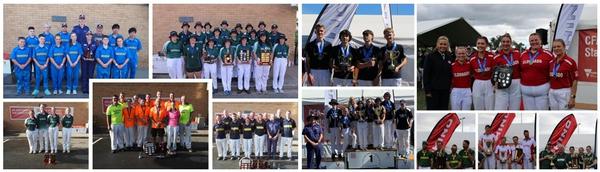
This year’s Championships saw just over 1,000 competitors, from 175 teams from across the State come together, joined by thousands of other CFA members, families and the general public to make an incredible melting pot that sits at the apex of the CFA calendar.
Members not only enjoyed the competitions but had the opportunity to meet and chat with CFA organisational units, members of the executive and board, as well as inspecting and providing feedback on equipment such as the next-gen pumper, CFA’s new driving simulator, as well as trying out the aviation simulator. Free health checks as well as a plethora of services to assist members with the VRH, LMS and other systems volunteers frequently rely.
The Championships represent the largest gathering of CFA members on an annual basis, with representatives from Western Australia and Tasmania joining us this year. The fact that numbers exceeded last year, even after an exhausting fire season and increased fuel costs - is testament to the dedication of
brigades and volunteers who use the annual competitions as a crucial way to keep members connected, maintain high morale and hone their fire ground skills in a friendly and fun - yet competitive - environment.
In fact, as previous Chief Officers have all testified, the annual championships
are one of CFA’s most effective and efficient training exercises in our arsenal to regularly prepare and exercise the skills and tactics that are used each year to protect life and property across Victoria.
With such a large gathering of members from across the State, it was also a crucial
opportunity for volunteers to discuss contemporary issues and debrief after what has been a busy summer. Getting such a cross mix of volunteers from right across the State also reinforced to me the value of VFBV’s broad consultative framework that ensures we are regularly informed by the broad and diverse range of brigades and volunteers from across the whole state.
Over the two weekends the face-to-face feedback was consistent with what has come
in through our local consultative forums and District Councils held across the State so far this year.
It was particularly humbling to receive overwhelmingly positive feedback about the mature and professional approach that VFBV has provided over recent months, especially given the
challenging environment and potential risks to volunteer reputation. Feedback also reinforced the importance of ensuring our work that often goes on behind the scenes to educate and build respect for volunteers not only across CFA but across the whole emergency management sector and government continues unabated.
Many voiced a strong desire for us to continue to resist partisan political headwinds that will only amplify as we move closer to this year’s State election; while ensuring we keep the heat on those decision makers who are responsible.
The anger and disappointment
towards government about its lack of support for CFA volunteers was evident, but not unexpected, as people reinforced the disconnect between government messaging and their actions on the ground. There continues to be a very strong desire to call out the meaningless drivel and spin from government and agency media releases and continue to focus on practical improvements that actually benefit volunteers and the communities they protect.
Most worryingly for me was the number of volunteers who expressed concerns and reservations from experiences encountered during the fire season but had decided not to raise it through formal channels. Almost always, the reason given was they didn’t feel it would make any difference and that CFA or government didn’t care, so what was the
point?
And while an element of this cynicism has always existed, I was concerned by the frequency it was raised, and the lack of confidence or trust people expressed in CFA’s after-action review process.
It is timely therefore for me to share some recent discussions with CFA to strengthen the AAR process and improve transparency and most importantly – action to actually fix the issues being raised.
For example, this year a greater emphasis on ground up feedback should be achieved by the Strike Team Leader, Sector and Divisional Commander surveys. These are in addition to the District AAR’s being held between now and the end of April. CFA have also agreed to improved cooperation with our CFA/VFBV Joint Operations Committees that will improve transparency while also providing a mechanism for volunteers to have input into the actions assigned to the
opportunities for improvement identified through this year’s AAR process.
However – this very much relies on feedback from you.
If you had a poor experience or have observations that you think relevant to this year’s fire season, please get involved. Search for “Post Season Debrief” on members online, or you should find a tile on the members online homepage that you can click.
Any individual may submit an observation.
VFBV’s focus will not just be on raising the concerns but simultaneously working with CFA to address them. And if the issue is outside CFA’s sphere of influence, then we will work with agency partners and government to try and have it
addressed.
In particular, I am keen to address those issues which have been persistent over the years and should no longer be occurring at all. While the fog of war in the very early days of a campaign fire can make logistics challenging, I continue to be frustrated by reports of strike
teams well into the season not receiving proper SMEACS briefings, not being tasked, or turning up to only be told they weren’t expected, or there isn’t any accommodation or food.
These are simply unacceptable and fails to recognise that volunteers are giving up the most precious thing they
have – their time. And CFA’s systems, oversight and accountability processes need to recognise this. In interagency settings, EMV must step up to provide the accountability and assurance across the agencies. If you are benefiting from the volunteer system you must equally be accountable for caring, nurturing and protecting it.
It is also timely to discuss flexible shift and deployment formats, acknowledging that not one format will suit everyone or even every District – but volunteers should be involved with how they are designed and implemented.
A very big theme raised
with me has been Comms, and in particular radios. I was shocked by how many people reported issues, but when asked if they had completed a radio observation report said no. In members online, search for “Operational Communications” and you will find a link to the Operations Communications Tools and
Applications. From here, you can report issues with paging, supplementary alerting, radio observations and more general communications observations.
When you make a report – each issue is allocated to a technician to investigate. This is the only way we can demonstrate widespread issues
that cannot be simply dismissed.
This is also the only way that problems with the radio network, towers, or handsets will be able to be diagnosed. The assumption that radios simply don’t work in smoke can sometimes be overstated and be a bit of misnomer, and reporting an issue allows
technicians to determine if the issue was a tower, channel, topography, or even user error, such as trying to use a portable radio when a mobile radio should have been used. It will also reveal if an IMT was not using the pre-determined comms plan and channel allocation – which will contribute significantly to the AAR process.
Another advantage to reporting a comms fault, is CFA can also use this data to report blackspot observations that the Commonwealth Government can then use to prioritise 4G and 5G blackspot remediation programs down the line.
It is also timely to
remind members that submissions to the Upper House Inquiry into the 2026 Summer Fires closes on the 19 April, 2026. This is the perfect opportunity to raise broader observations and impacts such as planned burning, budgetary pressures, the age of the fleet, lack of infrastructure,
maintenance, morale or workforce issues including lack of IMT training and mentoring/exercising that may have been observed during this year’s fire season.
No one can fix what they don’t know about, so I urge members to embrace the numerous opportunities available to provide
feedback.
Given we appear to be entering a window of heightened fire activity, the next few years could be challenging. But the challenge also presents an opportunity. It was Churchill who opined that those who fail to learn from the past are doomed to repeat it. As one of the most fire
prone places on the planet, Victoria has the distinction of being at the forefront of bushfire management. The decisions and actions we take today will not just influence emergency management in our little part of the world but may also inform other fire services right across the world.
Get involved and provide your feedback. Your feedback is what drives our advocacy and helps us try and effect change that benefits not only volunteers – but the very communities who rely on our duty and service. We simply cannot do it without you.